Why egocentric data from Europe is becoming a strategic input for robotics
The scaling bottleneck in robotics manipulation has shifted. For most teams building manipulation policies, the limiting factor is no longer the model architecture or the compute. It's the training data.
Specifically: first-person video of humans performing real-world tasks, annotated well enough to extract the signals a policy needs to learn from.
Why egocentric footage is different
A fixed camera on a robotic arm captures what the robot sees. An egocentric camera captures what a human sees while doing the same task. The difference matters for imitation learning and for training vision-language-action models, which need to generalize across environments, objects, and task sequences that weren't in the original training set.
NVIDIA's GR00T N1.7 research found that adding 20,854 hours of egocentric human video to a training mix doubled the policy success rate on manipulation benchmarks. The signal is in the human perspective, not just the task.
The problem with available datasets
Most publicly available egocentric datasets were collected in controlled lab environments, primarily in the United States. They cover a narrow range of settings and object types, and most predate the current generation of vision-language-action models that have raised the bar for annotation depth.
Free large-scale datasets have expanded significantly, but they come with tradeoffs: limited annotation layers, no provenance documentation, and collection conditions that don't reflect the environments where deployed robots will actually operate.
What changes with the EU AI Act
From August 2026, providers of high-risk AI systems under the EU AI Act will need to document the provenance, collection conditions, and annotation methodology of their training data. This applies to robotics systems listed under Annex III, and to foundation models used as components in those systems.
Most teams are not yet positioned to answer a compliance question about their training data. The datasets they're using don't carry that documentation. This is creating a divergence between teams that treat training data as a commodity input and teams that treat it as a documented, auditable asset.
What EgoVista provides
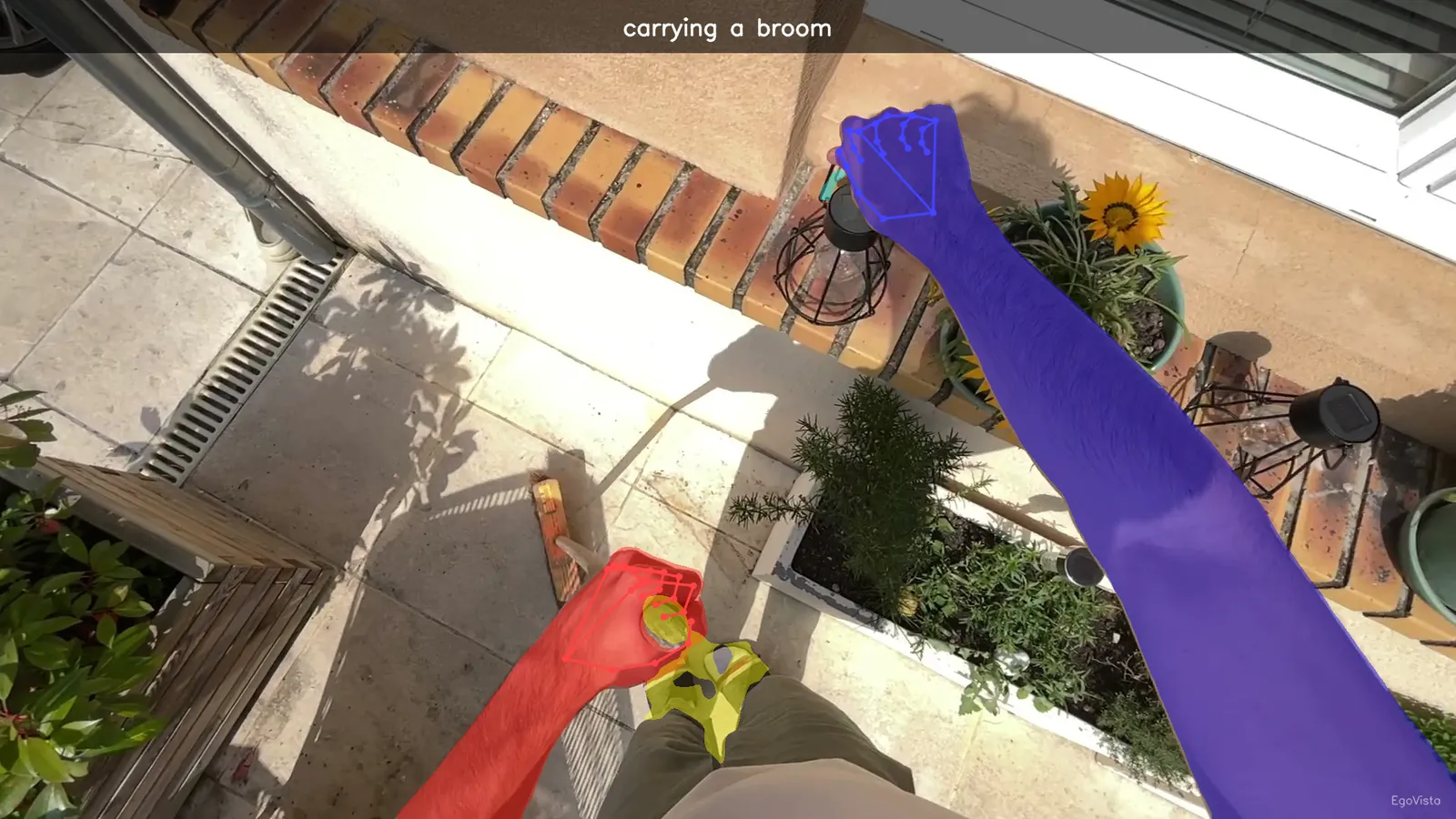
EgoVista collects egocentric video from contributors based in Europe, in real household environments. Each dataset is processed through a nine-layer annotation pipeline covering hand pose, depth estimation, hand-object segmentation, contact timing, and action labeling. Outputs are compatible with LeRobot and RLDS, the two formats most commonly used in manipulation policy research and development.
Collection is conducted under GDPR. Contributor consent is documented, footage is anonymized at source, and provenance is tracked per session.
For teams working on manipulation pipelines, we offer annotation on client-provided footage as well as sourced EU datasets. Both are delivered in training-ready formats with QA scoring included.
If you're working on a manipulation pipeline and want to see a sample, reach out at contact@egovista.app.